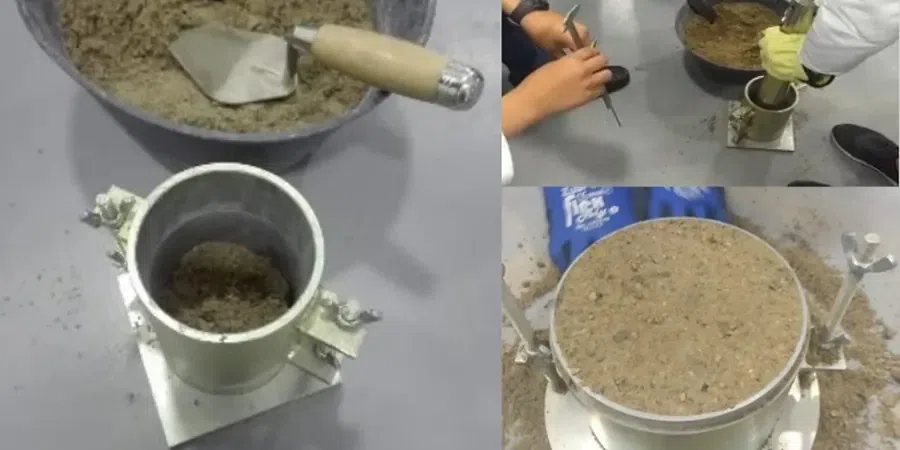
Between the alluvial flats of the Hastings River and the weathered metasediments of the Port Macquarie hinterland, the compaction behaviour of fill material shifts dramatically. A structural fill placed near Settlement Point on recent estuarine clays demands a completely different moisture-density relationship than a road base sourced from the rhyolite quarries west of Wauchope. Running a Proctor test in Port Macquarie on the actual borrow material, rather than relying on assumed values, is the only way to establish correct field density targets. This is where the standard AS 1289.5.1.1 procedure, executed in a NATA-accredited laboratory, becomes central to any earthworks specification. We routinely pair the Proctor with a sand cone density test for field verification on compacted layers, ensuring the achieved dry density ratio meets the 95% or 98% threshold specified by the project geotechnical engineer.
Compaction is not about adding water and rolling; it is about hitting the precise moisture content where particle rearrangement achieves maximum mechanical interlock for that specific Port Macquarie soil.
Scope of work
Area-specific notes
AS 3798-2007 sets clear compaction criteria for controlled fills, and the Proctor test is the backbone of that compliance framework. In Port Macquarie, where residual clayey sands and siltstones can exhibit collapse potential upon wetting, placing fill above the line of optimums without verified Proctor data introduces a risk of post-construction settlement that no amount of rolling can reverse. The coastal lowlands around the Hastings estuary also have shallow groundwater tables: fill compacted wet of optimum in these zones tends to trap pore pressure, leading to shear strength reductions detectable only through a proper moisture-density relationship. A Proctor test run on the actual site-won material removes the guesswork, providing the contractor with a defensible compaction curve that holds up during council inspections and NATA field density audits.
Standards used
AS 1289.5.1.1-2017, AS 1289.5.2.1-2017, AS 3798-2007, AS 1289.5.8.1-2007
Linked services
Standard Proctor (AS 1289.5.1.1)
Single-point and five-point Proctor curves using the 1.0 L mould, suited to residential and commercial earthworks in Port Macquarie with cohesive residual soils.
Modified Proctor (AS 1289.5.2.1)
High-compactive-effort testing for arterial road pavements, heavy industrial slabs, and airport runway fills requiring 98% relative compaction.
Field density (sand cone)
On-site density verification using AS 1289.5.8.1, correlated directly to the lab Proctor curve, with immediate reporting for contractor quality control.
Oversize rock correction
Correction of Proctor results for fills containing gravel and cobble fractions using the AS 1289 rock correction method when site material exceeds 20% retained on the 37.5 mm sieve.
Typical parameters
Top questions
What is the difference between Standard and Modified Proctor for a Port Macquarie subdivision?
The Standard Proctor applies 596 kJ/m³ of compactive energy and simulates typical pad-foot roller compaction, making it appropriate for residential allotment fills in Port Macquarie. The Modified Proctor delivers 2703 kJ/m³ and replicates heavy vibratory roller passes, typically specified for road subbases, commercial building pads, and RMS-controlled earthworks. The choice depends on the project specification: most local councils accept Standard Proctor for Class A and Class B fills under AS 3798, while arterial road projects require Modified Proctor targets.
How much does a Proctor test cost in Port Macquarie?
A standard five-point Proctor compaction test in our NATA-accredited Port Macquarie laboratory ranges from AU$150 to AU$280, depending on whether it is a single-point check or a full curve development. Modified Proctor tests sit at the upper end of that range due to the larger mould and additional compactive effort. Turnaround is typically 24 to 48 hours, and we can arrange sample collection from your site or stockpile anywhere in the Hastings-Taree region.
How many Proctor tests do I need for a bulk earthworks project?
AS 3798 recommends a minimum of one Proctor reference test per material type per 2,500 m³ of placed fill, or whenever the source material changes visually. In Port Macquarie, where cut-to-fill transitions between sandstone-derived gravels and clayey silts are common across a single site, we typically advise a new Proctor curve for each distinct geological unit encountered. Running a single Proctor on a blended stockpile without verifying in-situ variability can lead to false density readings during field nuclear gauge or sand cone checks.
What is the optimum moisture content and why does it matter?
Optimum moisture content is the water percentage at which a soil achieves its maximum dry density under a given compactive effort. In Port Macquarie's coastal clayey sands, OMC typically falls between 14% and 28%. Compacting significantly dry of optimum leaves a flocculated soil structure prone to collapse upon wetting; compacting wet of optimum in low-permeability fills can trap pore pressure and reduce shear strength. The Proctor curve pinpoints the target window for the roller operator, and field density testing then confirms whether that target was achieved.