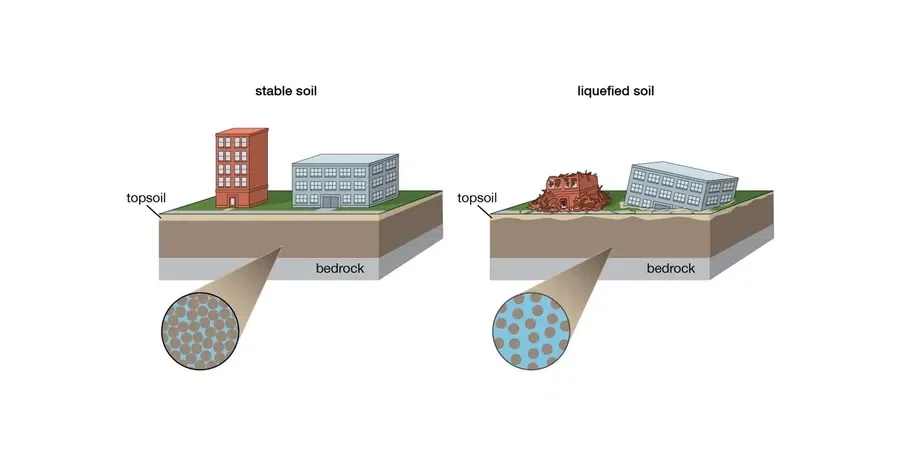
Port Macquarie sits where the Hastings River meets the coast, and much of the low-lying floodplain is underlain by Holocene sands and silty estuarine deposits that can exceed 15 m in thickness. With a site class that often falls into Ce or De under AS 1170.4, the potential for cyclic softening during a moderate earthquake is a real design constraint. Our laboratory runs liquefaction screening on thin-wall tube samples and SPT data supplied by local drillers, applying the Youd-Idriss (2001) NCEER workshop framework and checking the results against CPT-based triggering curves when cone data is available. For sites near Settlement Point or the canals, where the water table sits within 1.5 m of the surface, a post-liquefaction volumetric strain assessment is often what determines whether Improvement is needed before the footing design proceeds.
Liquefaction isn't just a sand-boil problem — in Port Macquarie the bigger cost driver is the reconsolidation settlement that follows cyclic pore-pressure dissipation.
Scope of work
Area-specific notes
The 2022 update of the National Seismic Hazard Assessment raised the 10 % in 50-year PGA for the Port Macquarie region to roughly 0.06–0.08 g, which may not sound high but is enough to trigger liquefaction in loose saturated sand lenses at depths of 2–7 m. The biggest risk on canal-front and riverside allotments isn't bearing capacity failure — it's differential settlement of 30–60 mm across a slab after pore pressures dissipate, cracking brick veneer and pulling services apart. If the fines content is underestimated because a driller’s SPT spoon washed out the silt, the factor of safety can be over-predicted by 20 % or more; that’s why we insist on undisturbed tube samples or at minimum a grain-size analysis paired with Atterberg limits before finalizing a liquefaction assessment. For subdivisions north of the Oxley Highway where fill has been placed over old estuary mud, a combined liquefaction and slope stability review is often the only way to satisfy Council’s geotechnical submission requirements.
Watch how it works
Standards used
AS 1726:2017 — Geotechnical site investigations, AS 1170.4:2007 (Amdt 2) — Structural design actions: Earthquake actions, Youd et al. (2001) — NCEER/NSF Liquefaction Resistance of Soils (summary report), AS 1289/D5311M-13 — Standard Test Method for Load Controlled Cyclic Triaxial Strength of Soil
Linked services
SPT-based simplified analysis
We process SPT N-values corrected for energy ratio, overburden, and fines content to calculate CRR and FoS per NCEER guidelines. This is the most cost-effective path for single-dwelling sites on the coastal plain, and we can often turn around a report within five working days if the borehole logs and samples are delivered to our lab.
Cyclic triaxial laboratory program
For larger subdivisions, canal-wall designs, or any site where the simplified procedure yields a borderline FoS, we run a suite of stress-controlled cyclic triaxial tests on reconstituted specimens to directly measure the cyclic resistance ratio. The program includes grain-size distribution, Atterberg limits, and moisture-conditioned sample preparation, with full pore-pressure and strain time histories in the final report.
Typical parameters
Top questions
What does a soil liquefaction analysis cost for a standard residential block in Port Macquarie?
For a typical single-lot investigation using SPT-based simplified analysis with one or two boreholes, the liquefaction assessment portion runs between AU$3,720 and AU$7,120 depending on the number of samples tested for fines content and whether cyclic triaxial verification is required. The final figure depends heavily on the drilling depth and how many layers need index testing before the cyclic program is scoped.
Do Port Macquarie Council development applications always require a liquefaction assessment?
Council’s geotechnical submission checklist triggers a liquefaction assessment whenever the site is underlain by sand or silt layers below the water table within a mapped seismic hazard zone. In practice, most canal-side and Hastings River floodplain sites will require one, particularly if the proposed construction is a Class 1a building with masonry veneer. The assessment must follow AS 1726 and demonstrate a factor of safety of at least 1.25 for the design earthquake event.
How long does it take to get the liquefaction report after drilling?
Once the borehole samples arrive at our laboratory, a standard SPT-based analysis with fines testing takes five to seven working days. If a cyclic triaxial program is needed, add another ten to twelve working days because the specimens must be reconstituted, saturated, and tested at multiple cyclic stress ratios to build a reliable CRR curve. We can provide a preliminary screening letter within 48 hours if the driller shares the field logs and water-table depth on the day of the investigation.