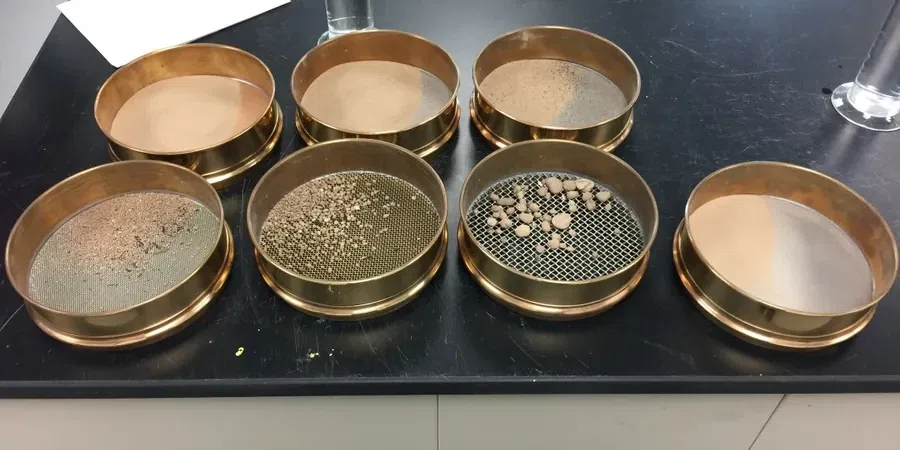
Port Macquarie’s coastal geology shifts abruptly over short distances—from clean estuarine sands near Settlement Point to deeply weathered residual silts just a few hundred metres inland. With over 50,000 residents and a construction sector that has not stopped growing since the 2020 regional migration surge, getting the particle size distribution wrong is not an option. A grain size analysis (sieve + hydrometer) pinpoints the exact proportion of gravel, sand, silt, and clay in a sample. That split controls permeability, compaction response, frost susceptibility, and—critically—how a footing will drain after a heavy East Coast Low. Our laboratory runs the full stack: mechanical sieving down to 75 µm followed by hydrometer sedimentation per AS 1289, with results reported against AS 1726 classification tables. For sites near the Hastings River floodplain, we often pair this data with Atterberg limits to nail down the plasticity characteristics that the gradation curve alone cannot reveal.
A single grain size curve drawn from Port Macquarie alluvium tells you more about drainage and compaction than a dozen SPT blows alone.
Scope of work
Area-specific notes
A residential subdivision carved into the weathered metasediments west of the Pacific Highway recently hit a layer of silty sand that looked competent in the hand-auger log. The developer proceeded with standard footing designs based on visual classification alone. Six months after handover, three slabs showed differential movement exceeding 15 mm. The culprit? A grain size analysis we ran post-incident revealed 42% silt content—material that had been misidentified as clean sand. That level of fines creates a soil that holds pore water, loses strength when saturated, and consolidates slowly under load. AS 4678 explicitly requires particle size distribution data for any engineered fill or retaining structure over 1 m in height. Skipping the hydrometer step on a flood-prone Port Macquarie lot means guessing at the most dangerous fraction of the soil—and that guess has real consequences for slab performance and stormwater infiltration.
Standards used
AS 1726: Geotechnical site investigations, AS 1289: Standard test method for particle-size analysis of soils (hydrometer), AS 1289: Standard test methods for particle-size distribution (sieving), AS 4678: Earth-retaining structures (drainage and backfill requirements), AS 1289.3.6.1 & AS 1289.3.6.3: Soil classification tests
Linked services
Standard sieve + hydrometer package
Combined mechanical sieving (75 mm down to 75 µm) and hydrometer sedimentation per AS 1289/D6913. Includes full gradation curve, D-values, Cu, Cc, and AS 1726 soil classification. Recommended for all foundation investigations and earthworks QA on the Mid North Coast.
Wash-sieve analysis for high-fines materials
For silty sands and clayey gravels common in Port Macquarie’s residual profiles, we run a wash-through 75 µm sieve before dry-sieving the retained fraction. This prevents fine-particle agglomeration from skewing the sand percentage and gives a truer picture of the soil’s drainage potential.
Typical parameters
Top questions
How much sample material do you need for a full grain size analysis in Port Macquarie?
We typically require 500 grams of air-dried material for sandy soils and about 200 grams for the hydrometer portion of fine-grained samples. If the soil contains gravel, a larger bulk sample of 2 to 3 kg may be needed to ensure the coarse fraction is representative. Our team can advise on sample size once we know the borehole log and expected geology.
What is the typical turnaround time for a grain size report?
Standard turnaround is five working days from sample receipt. We offer a 48-hour fast-track service for active construction projects where earthworks compaction or fill acceptance depends on the gradation data. The hydrometer portion requires a 24-hour sedimentation reading, which sets the minimum possible turnaround.
Do you provide the USCS classification along with the AS 1726 classification?
Yes, every grain size report includes both the Unified Soil Classification System (USCS) symbol and the equivalent AS 1726 descriptive classification. The gradation curve, D10, D30, D60, Cu, and Cc values are all presented on a single semi-log plot with the relevant classification boundaries marked.
What does a grain size analysis cost for a typical residential site in Port Macquarie?
For a standard sieve-plus-hydrometer package on a single sample, prices range from AU$160 to AU$260 depending on the proportion of coarse material and whether a wash-sieve step is needed. Multi-sample projects and ongoing earthworks contracts can be quoted at reduced per-sample rates.