A common mistake on Port Macquarie sites is treating soft estuarine clay as a simple fill-and-compact problem. The Hastings River floodplain and coastal inlets contain compressible silts and organic layers that consolidate unevenly under load. Stone column design bypasses this by installing dense granular columns through the weak strata, transferring load to competent bearing layers while accelerating drainage. The method works well in Port Macquarie because it handles variable groundwater tables typical of coastal New South Wales. Our team provides the design parameters—friction angle of the gravel, undrained shear strength of the surrounding soil, and settlement estimates—before a single rig mobilizes. We also combine the CPT test to map soft zones continuously and the triaxial program to confirm gravel stiffness under confinement.
Stone columns in Port Macquarie alluvium cut settlement by 40-60% while providing a reliable drainage path—two problems solved with one Improvement technique.
Scope of work
Area-specific notes
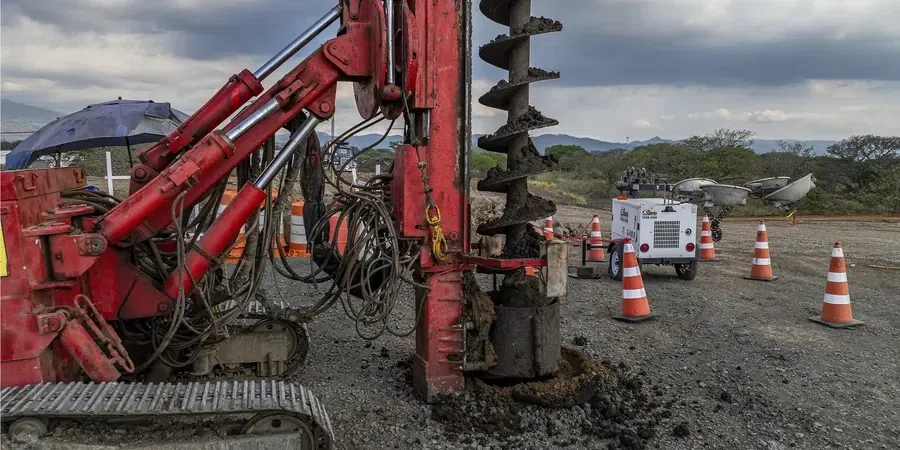
The vibroflot rig used in Port Macquarie is a crawler-mounted unit with a 130–180 kW hydraulic motor driving an eccentric weight at 1800–3000 rpm. It penetrates under its own weight assisted by water jets or compressed air. The risk stage is column continuity. In estuarine clays with organic lenses, the gravel can neck or bulge if backfill feed rate doesn't match extraction speed. We monitor this during trial columns and correlate with post-installation CPT profiles. A poorly installed column becomes a weak point in the grid—excess pore pressure concentrates there, and differential settlement appears within months. Our lab testing of the gravel gradation confirms it meets AS 4678 drainage criteria. We also check for fines content below 5% to prevent clogging. In Port Macquarie's sensitive clay zones, column shear failure at the top is the failure mode we design against most carefully.
Standards used
AS 4678 – Earth-retaining structures, AS 1726 – Geotechnical site investigations, AS/NZS 1170 – Structural design actions, AS 1289 – Methods of testing soils for engineering purposes
Linked services
Design parameter testing
Triaxial CD and CU tests on gravel samples to define Ø' and c' for column material, plus consolidation and strength testing of the surrounding soft soil to determine composite ground modulus.
Post-installation verification
Correlation of pre- and post-installation CPT profiles across the treatment grid. We provide settlement plates and pore pressure transducer monitoring during surcharge loading.
Typical parameters
Top questions
What is the cost range for stone column design in Port Macquarie?
Design packages for Port Macquarie sites typically range from AU$2,180 for a single structure on a known soil profile up to AU$8,270 for larger commercial lots requiring trial columns, laboratory testing, and full verification reporting.
How deep can stone columns be installed in Port Macquarie soils?
Most installations in Port Macquarie reach 6 to 15 metres depth, terminating in dense sand or weathered rock. The vibroflot can penetrate deeper, but column continuity must be verified with CPT when depths exceed 12 metres in soft alluvium.
Does stone column design reduce liquefaction risk?
Yes. The columns act as vertical drains that allow rapid dissipation of earthquake-induced pore pressures, and the densification of the surrounding soil during installation increases its cyclic resistance ratio. This is particularly relevant for Port Macquarie's coastal sand deposits.
What laboratory tests are required before stone column design?
We require at minimum particle size distribution of the gravel, undrained triaxial or vane shear strength of the soft soil, and consolidation tests for settlement prediction. If drainage is a design function, constant head permeability tests on the gravel are also performed.