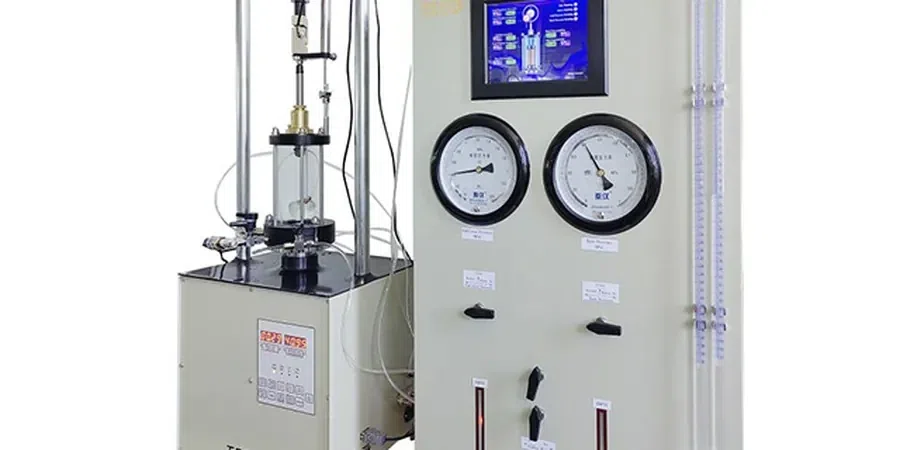
The ground changes fast between the old floodplain near Settlement Point and the hilltop subdivisions off Pacific Drive. Down by the river you’re looking at soft silty clays that barely hold a 50 kPa bearing pressure, while up on the slopes you hit stiff residual clay over weathered phyllite. Same postcode, completely different effective stress behaviour. That’s where a well-run triaxial test stops being a lab checkbox and starts being the difference between a footing that settles evenly and one that tilts. We run drained and undrained triaxial programs calibrated to exactly that kind of site variability, with specimen preparation that preserves the in-situ fabric of Port Macquarie’s coastal plain materials. When the borelog shows a mix of fine sand and clay lenses, we’ll often pair the triaxial work with a grain-size analysis to pin down the silt fraction and confirm drainage assumptions before the cell pressure goes on.
A single consolidated-undrained triaxial test on Port Macquarie’s estuarine clays tells you more about foundation risk than a dozen SPT blows.
Scope of work
Area-specific notes
Port Macquarie sits at roughly 5 metres above sea level across much of the CBD, and the 2021 floods reminded everyone that the water table here isn’t a static number — it responds hard to La Niña rainfall events. Triaxial specimens taken from silty clay layers below the groundwater table often show Af values above 0.8, meaning the pore pressure builds fast under load and the effective stress drops quicker than a total-stress analysis would predict. If the lab runs a quick unconsolidated-undrained test without back-pressure saturation, the numbers look fine on paper but the real shear strength is lower. That mismatch has caused retaining wall failures along the Hastings escarpment and slab heave in light industrial sheds near the airport. We’ve learned to insist on CU with pore pressure measurement for any project where the finished floor level sits within 1.5 metres of the seasonal high water table, which covers most of the Port Macquarie coastal zone.
Standards used
AS 1726:2017 Geotechnical site investigations, AS 1289.6.4.1 Soil strength and consolidation tests — Determination of compressive strength — Triaxial compression test, AS 4678:2002 Earth-retaining structures, AS/NZS 1170.0:2002 Structural design actions
Linked services
Consolidated-Undrained (CU) Triaxial with Pore Pressure
The workhorse test for Port Macquarie’s estuarine clays and silty sands below the water table. We back-saturate to B ≥ 0.95, consolidate isotropically at three effective confining stresses matched to the design profile, then shear undrained while logging pore pressure continuously. You get effective stress parameters c’ and φ’ plus Skempton’s A coefficient at failure.
Unconsolidated-Undrained (UU) Triaxial
Used for short-term stability checks in clay fill and soft alluvium where drainage isn’t expected during construction. We run three specimens at different cell pressures and report undrained shear strength Su. Fast turnaround is possible when the site is uniform and the borelog is clean.
Multi-Stage Triaxial Testing
When core recovery from a critical Port Macquarie layer is poor and you’ve only got one decent Shelby tube, a multi-stage CU test on a single specimen can yield a failure envelope without running three separate samples. Not a substitute for a full program, but a pragmatic option for investigation-phase budget constraints.
Typical parameters
Top questions
What does a triaxial test cost in Port Macquarie?
A standard three-specimen CU triaxial program with pore pressure measurement typically runs between AU$2,850 and AU$4,100 depending on specimen preparation time, confining pressure range, and whether we’re working with undisturbed tube samples or recompaacted material. UU programs are on the lower end. Multi-stage tests fall in the middle. We provide a fixed quote once we’ve seen the borelog and the testing schedule.
Which triaxial test type do I need for a retaining wall design in Port Macquarie?
For a retaining wall on the coastal plain or along the Hastings River, we nearly always recommend consolidated-undrained triaxial with pore pressure measurement. Port Macquarie’s shallow groundwater means drained conditions can’t be assumed during construction, and the CU test gives you effective stress parameters for long-term design plus undrained strength for the short-term case. AS 4678 references both, and having both data sets avoids conservative assumptions that inflate the wall section.
How long does a triaxial test program take from sample receipt to report?
A CU triaxial program on three specimens from a cohesive soil usually takes 7 to 10 working days from sample extrusion to final report. Consolidation alone can take three to six days depending on the clay permeability. UU programs are faster — often four to five working days. We’ll give you a realistic timeline during sample inspection and we don’t rush consolidation because cutting it short biases the shear stage data.
Do you need undisturbed samples or can you test recompaacted material?
We can do both, but the approach is different. Undisturbed Shelby tube samples give you the in-situ fabric and stress history, which is what you want for foundation design in Port Macquarie’s sensitive estuarine clays. Recompaacted specimens are useful for fill quality control or when you’re evaluating borrow material, and we compact to the target density and moisture content you specify. The test report clearly states whether the specimen was undisturbed or recompaacted so there’s no ambiguity in the design parameters.