The rotary-percussive rig sets up on a tight Mid North Coast site, its mast tilting to match the design inclination before the duplex drilling begins through Port Macquarie's residual clayey sands. An active anchor is a tensioned tendon that transfers load into competent ground well behind a potential failure plane, while a passive anchor relies on ground deformation to mobilise resistance. The distinction matters here because the deeply weathered metasediments underlying the Hastings River floodplain can creep under sustained load, making the locked-off force in an active system critical for controlling wall deflection. For deep basement excavations near Settlement Point, we frequently combine a row of active strand anchors with a slope stability assessment to verify that the global factor of safety remains above 1.5 during staged excavation.
A properly proof-tested anchor in Port Macquarie's residual profile should show less than 2 mm of creep during the 15-minute hold period.
Scope of work
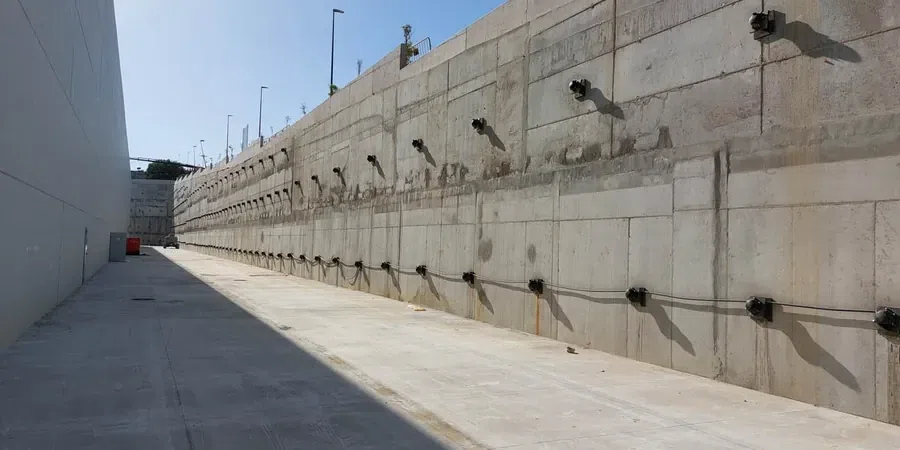
Area-specific notes
A four-storey mixed-use building on Hayward Street required a 6-metre-deep cut adjacent to an existing brick-veneer residence built in the 1970s. The original design assumed competent sandstone at 3 metres, but the boreholes revealed a lens of saturated silty sand that hadn't appeared on the preliminary desktop study. Without active anchors tied back into the sandstone, the temporary batter would have needed a 1:1 slope that ate into the neighbour's setback. The solution was a single row of 200-kN active strand anchors at 2-metre centres, proof-tested to 250 kN before the waler was stressed. Dewatering was handled with a spear-point system, and an in-situ permeability test confirmed the drawdown radius was sufficient to keep the excavation dry during the anchor installation window.
Watch how it works
Standards used
AS 4678:2002 – Earth-retaining structures, AS 1726:2017 – Geotechnical site investigations, AS/NZS 1170.0:2002 – Structural design actions
Linked services
Design of prestressed active anchors
Full tendon selection, bond length calculation, and lock-off force specification for anchored retaining walls and basement slabs subject to uplift.
Passive anchor and soil nail design
Non-stressed reinforcement for slope stabilisation and landslide repair, including nail spacing, length, and facing connection details.
On-site anchor testing and supervision
Proof loading, creep monitoring, and lift-off testing in accordance with AS 4678 acceptance criteria, with real-time load-displacement logging.
Typical parameters
Top questions
What is the difference between active and passive anchors?
Active anchors are tensioned against the structure during installation, applying a pre-compression to the retained ground and limiting movement from the start. Passive anchors are not prestressed; they develop resistance only after the ground deforms enough to mobilise the load. In Port Macquarie's sensitive residual soils near the CBD, active anchors are usually preferred for deep excavations because they control lateral deflections more predictably.
How long does an anchor design and installation take in Port Macquarie?
A typical design and construct program for a single-level anchored wall runs 3 to 5 weeks. The site investigation and laboratory testing phase takes the first 7 to 10 days, followed by detailed design and then drilling and stressing. Weather windows matter here, especially during the January–March wet season when saturated ground can slow drilling rates in the clay-rich residual profiles.
What does an active anchor system cost in the Mid North Coast?
For permanent active anchors in Port Macquarie, pricing typically ranges from AU$1,380 to AU$6,400 per anchor installed and tested. The final figure depends on the bond length, whether the anchor requires duplex drilling through cobbles, the corrosion protection class, and the number of proof tests specified. Temporary passive nails fall at the lower end of that range.