Compaction performance varies dramatically between Port Macquarie's coastal floodplains and the elevated clay soils around Thrumster. A roadway base that passes inspection near Settlement Point can fail just a few kilometres inland if placed on reactive ground. The sand cone field density test provides the direct evidence engineers rely on. Our team deploys calibrated sand cone apparatus across Port Macquarie, from residential slabs in Lake Cathie to commercial carparks in the CBD. CBR testing for roads often follows when pavement layers need strength verification beyond density alone. We measure in-place density against the laboratory maximum from a Proctor test, delivering a definitive compaction ratio within hours of the field work.
The sand cone remains the referee test in Australian earthworks: direct, physical, and independent of moisture assumptions.
Scope of work
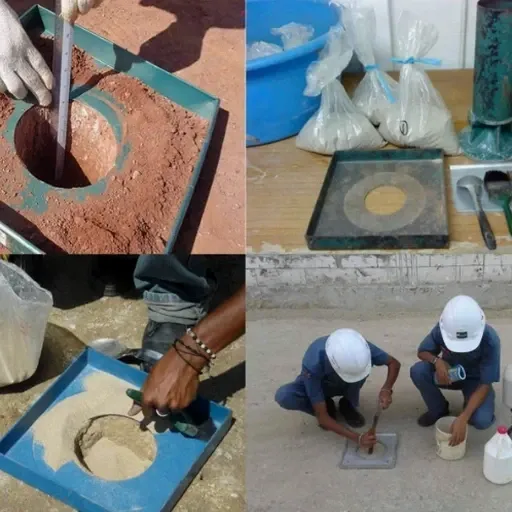
A calibrated Ottawa sand of known gradation flows into the excavated hole; we weigh everything on site with a portable balance. The calculation yields wet density, and a companion moisture sample from the same hole converts it to dry density. Key characteristics of our Port Macquarie testing program:
- Immediate reporting with compaction ratio, moisture deviation, and pass/fail against specification.
- Testing on graded fills, trench backfill, retaining wall zones, and pavement subgrades.
- Equipment verified daily against NATA reference standards and recalibrated for each sand batch.
Area-specific notes
The technician arrives with a rigid steel base plate, a calibrated sand cone jar, a chisel, and a precision balance. Everything fits in a single field kit, yet the entire pass/fail decision for a compacted lift hangs on how carefully that kit is used. Vibration from nearby compaction equipment can settle the calibration sand before the valve opens, artificially inflating the hole volume. In Port Macquarie's sandy coastal strips near Flynn's Beach, loose sidewalls collapse during excavation and the test must be abandoned. The biggest source of error is moisture loss from the excavated soil before it hits the sealed bag. Our team works fast in the Port Macquarie humidity, sealing samples within 30 seconds and storing them in insulated containers until the lab oven.
Watch how it works
Standards used
AS 1289.5.3.1 – Field density (sand replacement method), AS 1289.2.1.1 – Field moisture content (oven drying), AS 3798 – Guidelines on earthworks for commercial and residential developments
Linked services
Compaction Control for Earthworks
Layer-by-layer density verification during bulk filling, trench reinstatement, and retaining wall backfill. We test each nominated lift before the next is placed. Reports include compaction ratio, moisture deviation, and corrective recommendations if the specification is not met.
Road Base and Pavement QA
Pre-sealing density checks on bound and unbound pavement layers across Port Macquarie subdivision projects. Testing follows RMS QA Specification R44 where applicable, with results formatted for council submission.
Typical parameters
Top questions
How much does a sand cone density test cost in Port Macquarie?
A single field density test typically ranges from AU$140 to AU$220, depending on location within the Port Macquarie area and the number of points scheduled on the same day. Volume discounts apply for ongoing subdivision work with five or more tests per visit.
When can you test after the last compactor pass?
We can test immediately after the last pass, provided the surface is stable and the roller has finished. There is no mandatory waiting period for the sand cone method, unlike nuclear gauge testing which may require a separate moisture calibration for local Port Macquarie soils.
Do you provide a NATA-endorsed report?
Yes. All sand cone field density reports are issued under our NATA accreditation and include the full compaction curve overlay, moisture content, field density, compaction ratio, and a clear pass/fail statement against the specification nominated by the project engineer.