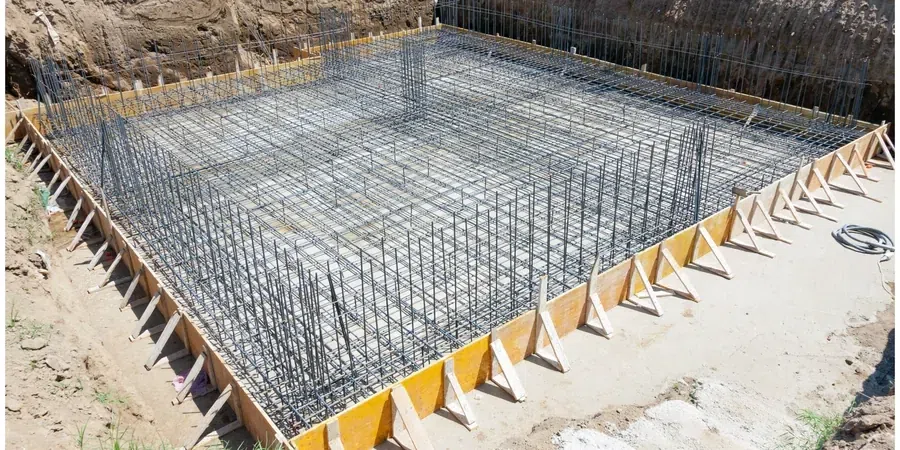
Port Macquarie’s coastal geology is a patchwork of Pleistocene sands, estuarine silts, and residual clay derived from the underlying Triassic sedimentary rock. The Hastings River floodplain, where much of the city’s expansion occurs, often conceals soft alluvial deposits extending to depths of 8 to 15 metres before reaching competent bearing strata. A conventional isolated footing simply cannot perform under these conditions without excessive differential settlement. Raft/mat foundation design becomes a necessity rather than an option when the soil profile consists of highly compressible clays interbedded with loose sand lenses. Our team works directly with the AS 2870 site classification framework, integrating borehole data from the SPT drilling campaign to model soil-structure interaction. For sites near the coastal dune systems east of the Pacific Highway, the proximity of the groundwater table—often less than 1.5 metres below the surface—demands rigorous buoyancy checks and a drainage strategy engineered into the raft slab.
A properly designed raft foundation transforms a marginal site—where differential settlement would crack a conventional slab—into a stable platform that performs for decades.
Scope of work
Area-specific notes
The risk profile for raft foundations differs markedly between the elevated terrain west of Port Macquarie and the low-lying coastal plains. On the western side, where residual clay overlies weathered argillite, the primary concern is shrink-swell movement driven by seasonal moisture variation—a characteristic behaviour of reactive soils classified as H1 or H2 under AS 2870. In these areas, an inadequately stiffened raft will experience edge heave and centre cracking within the first two wet-dry cycles. The eastern plains present a completely different mechanism: long-term consolidation of thick compressible layers, which can produce settlement that continues for years after construction. Here, the risk is not cracking from cyclic movement but a progressive loss of floor level and potential damage to underground services. A third scenario emerges near the canal estates where saturated loose sands could liquefy under seismic loading; we address this through Improvement strategies or by deepening the raft foundation to bypass the liquefiable horizon entirely.
Standards used
AS 2870-2011, AS 3600-2018, AS/NZS 1170.0:2002
Linked services
Geotechnical model development
We construct a 3D ground model from borehole logs, CPT soundings, and laboratory test results to define the spatial distribution of soil stiffness and strength for input into the foundation analysis.
Soil-structure interaction analysis
Using finite element methods, we simulate the response of the raft slab under serviceability and ultimate limit state loads, ensuring that predicted settlements and angular distortions comply with AS 2870 performance criteria.
Buoyancy and drainage design
For high-water-table sites common across Port Macquarie's coastal strip, we design underslab drainage blankets, submersible pump systems, and verify the structural dead load exceeds hydrostatic uplift forces by the required safety margin.
Typical parameters
Top questions
What is the typical cost range for a raft foundation design report in Port Macquarie?
The professional fee for a complete raft/mat foundation design package generally falls between AU$1,540 and AU$6,790, depending on the complexity of the soil profile, the building footprint, and the number of load combinations that require analysis.
What site investigation is needed before designing a raft foundation?
You will need at least two boreholes or CPT soundings extending to a depth of 1.5 to 2 times the raft width below the proposed underside. The investigation should include laboratory classification tests, consolidation tests on cohesive layers, and strength tests such as triaxial compression. Groundwater monitoring over at least one tidal cycle is also recommended for sites near the Hastings River or the coast.
Can a raft foundation be used on a sloping site in Port Macquarie?
Yes, but it requires careful stepping of the slab or a combination with deep edge beams to maintain the required embedment and lateral restraint. On slopes steeper than 1 in 10, the foundation design must also address global slope stability, particularly where the raft transfers load to the underlying weathered rock profile that may dip toward the excavation.